
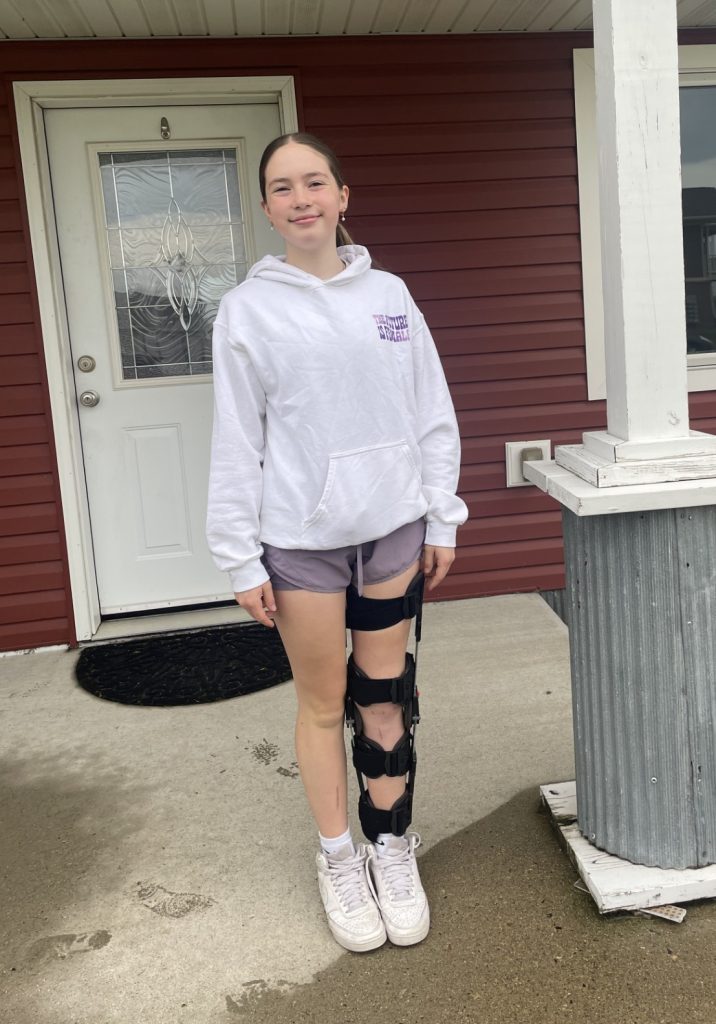
At a basketball game in February, thirteen-year-old Daisy Carlson hurt her knee but wasn’t sure how bad. A few weeks later, an MRI revealed a torn ACL, torn Meniscus, and a strained MCL.
She was devastated – her upcoming track season was over, and her basketball future was uncertain. After undergoing ACL and medial meniscus repair surgery, Daisy finally had a reason to feel hopeful. Perham Health physical therapist Pete Anderson, DPT, would soon become an important part of her recovery journey.
Partnering with Pete in Therapy for Recovery
Daisy began working with Pete a few days after her surgery, making her the youngest ACL therapy patient Pete has worked with. However, her age wasn’t about to stop her. Daisy set goals of being able to play basketball again and run at the same level she was running before her injury. Then she and Pete got to work, and they currently meet twice a week for rehabilitation.
 Once her care team lifted the movement restrictions, Daisy’s rehab program started with stretching.
Pete says, “Our first focus is on the fundamentals. We isolate muscle groups to regain strength, which is the most efficient method.” He then introduces more functional activities like leg extensions, squats on uneven surfaces, and balance exercises.
Pete also gave Daisy exercises and started her on a running program at home. “Pete put me on a running program where I run every other day. I’m running for four minutes and walking for three minutes. In a couple of days, I’ll be running for five minutes and walking for three minutes, and then it just progressively gets harder,” explains Daisy.
“We are now at the point where we are working on sprinting and cutting activities, as they are more sport-specific,” says Pete. Another important component in Daisy’s rehabilitation program is jumping mechanics. Pete guides Daisy through exercises, including double-leg, single-leg, box jumps, and agility ladder work.
Building Strength Mentally and Physically Through Therapy
Rehabilitation isn’t easy, and Daisy mentioned that she sometimes gets frustrated, “like when I watch my friends play and do their sports.” Pete says, “The first several weeks of rehab for this are usually pretty tough emotionally for students. Their injury has taken away their ability to do the things they love, and they are fully aware that it’ll be a long road to recovery. Then, usually around weeks 6-8, they start feeling much better, having little to no pain, and can walk without a limp, a brace, or crutches. Being able to do so represents a return toward normalcy and is typically a big boost for the patient, and it was for Daisy.”
Daisy, a driven athlete, has a background in gymnastics that helped her recover. Pete says of Daisy’s gymnastics training, “They (gymnasts) spend so much time learning how to control and change their body position; this is extremely important in therapy.”
Advice for Other Young Athletes
Almost five months into her rehab, Pete is very impressed with Daisy. “Daisy has done an outstanding job in therapy and was ahead of the curve the entire time. She regained her full mobility much faster than most patients do, demonstrates great strength and stability, and has a tremendous work ethic.”
Daisy reciprocates the respect, saying Pete, “pushes me hard, but not too hard where I get hurt. He’s encouraging. I don’t always want to get up in the morning and go to therapy, but I feel a sense of achievement afterward.”
Daisy has advice beyond her years for kids her age who get injured and need to undergo rehabilitation: “Don’t rush it during your recovery. Just wait and do it right. Don’t skip any of your exercises, and just remember that it is going to get better.”
Helping Patients Return to What They Love
Pete says he enjoys working with patients of all ages at Perham Health Physical Therapy. “We are always working to help patients achieve their goals and potential. Whether they are returning to the court or field, playing on the ground with their grandchildren, or anything in between.”
Look for Daisy competing on a track or court near you in the near future!
Learn more about Pete Anderson and physical therapy.

Pete Anderson, DPT
About Perham Health
Perham Health is a 25-bed Critical Access Hospital with three primary care clinics, a 96-bed nursing home, home health care agency, adult day services, memory care assisted living, and senior housing. The medical staff consists of 24 physicians, a nurse midwife, 14 advance practice clinicians, and three chiropractors. Visit perhamhealth.org to learn more.
Our content is for informational purposes only and should not be relied upon as medical advice. The content is not designed to replace a physician’s medical assessment and medical judgment. As always, please consult first with your physician about health matters.




I’ve had Pete several times myself. He does a good job