
Debra Johnson had a stroke that left her without a voice for two years. Now, with the help of Perham Health’s speech pathologist Laura Nyhus, MS, CCC-SLP and a voice output communication device, she is able to express herself and regain her independence.
In 2020, Debra had a stroke that left her unable to use the right side of her body or speak. Physical and occupational therapy helped her to regain partial use of her right arm and leg, however, after many rounds of speech therapy, Debra’s voice did not come back. Laura mentioned that Debra might benefit from a speech communication device that would speak for her, but Debra was still recovering and wasn’t ready for it yet.
For the last couple of years, Debra learned to use body language and facial expressions to communicate, and her husband Steve helped too. However, she found it frustrating to not be able to speak for herself.
Without speech, she was limited in what she could communicate. It was like playing a game of charades.
Being unable to communicate puts her at risk in emergency situations. If she dialed 911, she wasn’t able to tell them what was wrong or where to come. Also, if people call, she can’t tell them what she is doing or where her husband Steve is. She found it difficult to participate in conversations.
Ready to move forward
After two years, Debra finally felt ready to discuss a speech communication device so she made an appointment with Laura to learn more.
A speech communication device speaks for the person. It looks like an iPad and can be programmed to say words and phrases. It uses a touch screen with icons that can be programmed into categories like family, restaurants, going to the doctor and other topics or activities. Debra was able to select a natural sounding female voice for her device.
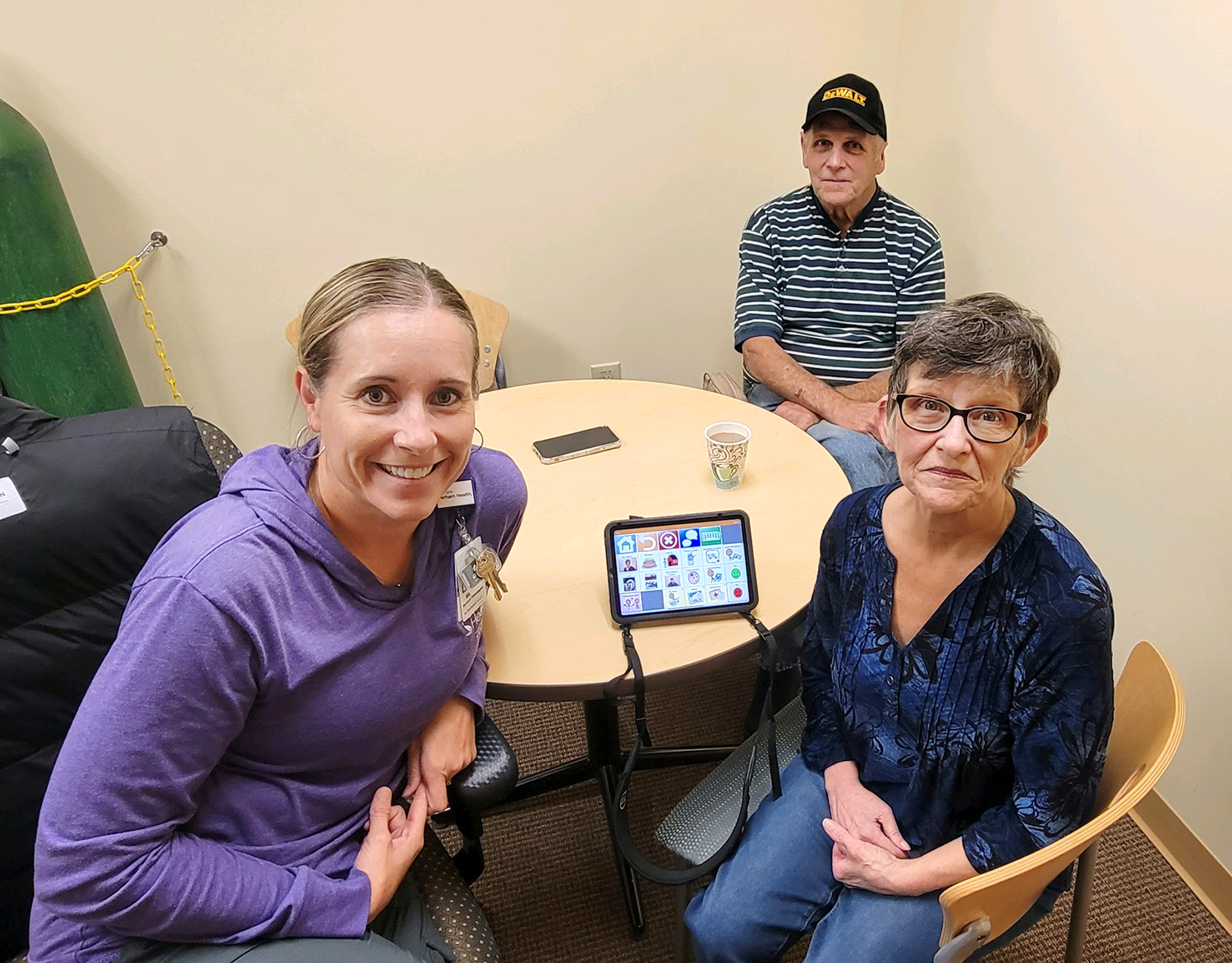
During their therapy sessions, Laura has been programming the device and teaching Debra how to use it.
Laura says “We program it with things that are important to Debra. Her family likes to go to restaurants so we added the menus of her favorite ones. She is able to select the restaurant, open the menu, select what she wants to eat, and the device will say it out loud to the waiter. This allows her the freedom to order for herself.”
The device has been programmed with information about Debra. It will speak her name, address, phone # and her favorite things. They uploaded pictures of her family and added information about them and their relationship to Debra, “she is able to use it to tell people that her grandson is at college in Alexandria,” says Laura.
She can now communicate at her doctor’s visits. She is able to tell her provider if she is in pain, what kind of pain and what part of her body is hurting. Recently, she was having eye issues and she was able to tell her provider that her vision was blurry and they were able to do something about it.
Bible study is very important to Debra. Previously, she was only able to listen. Now, she can attend bible study and contribute to the discussion. Her device has been programmed with things she would say or questions she would ask in a bible study.
Debra keeps track of things she would like added to her device and she and Laura work together to get them added during her speech therapy sessions. The device is easy to program so family and friends can help too.
Another important part of her therapy is practicing starting conversations. Since Debra hasn’t spoken in two years, she isn’t in the habit of starting conversations. Currently, Debra is practicing using the device to start and carry on a conversation so she can be more engaged.
“During therapy, we practice having her start conversations and I’ll respond and she’ll have to ask me another question. This way we practice having a conversation. These discussions lead to adding new items to her device. Then we practice how to find it on the device. Debra is making great progress,” explained Laura.
Debra says her quality of life has improved, and her husband Steve agrees. “It’s helped quite a bit. She can share how she is feeling if she is happy or upset. Or it helps me understand who she’s talking about. I understand better what she is trying to say.”
Laura has noticed a huge difference in Debra. “She is able to talk to her friends and engage in her Bible studies. She can talk with her grandkids or share information with people. Most importantly, she can handle an emergency situation,” she says.
The speech communication device has given Debra back her voice and her independence. Debra says, “I feel a part of the conversation again.”
Learn more about Speech Therapy and Laura Nyhus.

Public Relations
About Perham Health
Perham Health is a 25-bed Critical Access Hospital with three primary care clinics located, a 96-bed nursing home, home care agency, adult day services, memory care assisted living, and housing. The medical staff consists of 25 physicians, a nurse midwife, 15 advance practice clinicians, and three chiropractors. Visit perhamhealth.org to learn more.



Leave A Comment